Be Future-Ready
McKinsey says, “Stores, logistics systems, distribution facilities and supplier networks weren’t engineered for the rapid shifts in demand patterns we’re seeing today.” That’s true, with the exception of this national grocer’s regional distribution center (DC).
When they partnered with KNAPP to build their new DC, the food retailer’s design request was to be “future-ready.” They wanted the DC to:
- Get better over time by continuously driving performance increases over its 15-year life
- Quickly adapt to changing conditions with logistics systems that had inherent flexibility
- Be software-driven to make it easier to implement changes
- Reduce operator interactions, optimize headcount and make it possible for people to work in close proximity
- Evolve as they evolve to enable change in times of great uncertainty while still maintaining profitability
KNAPP recommended another criteria: the ability to add fulfillment at a later date with minimal disruption to the existing DC.
By leveraging modular autonomous robotics, intelligent logistics software and sector-specific expertise, the food retailer’s DC is the epitome of low-touch efficiency.
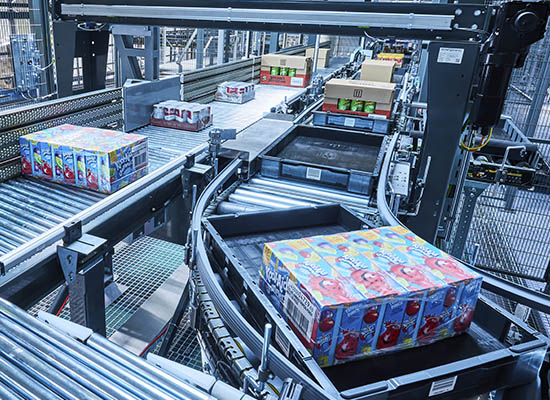
- A high-velocity shuttle system stores and retrieves items in the ideal sequence and calculates optimal stacking patterns for enhanced stability and store-friendly replenishment
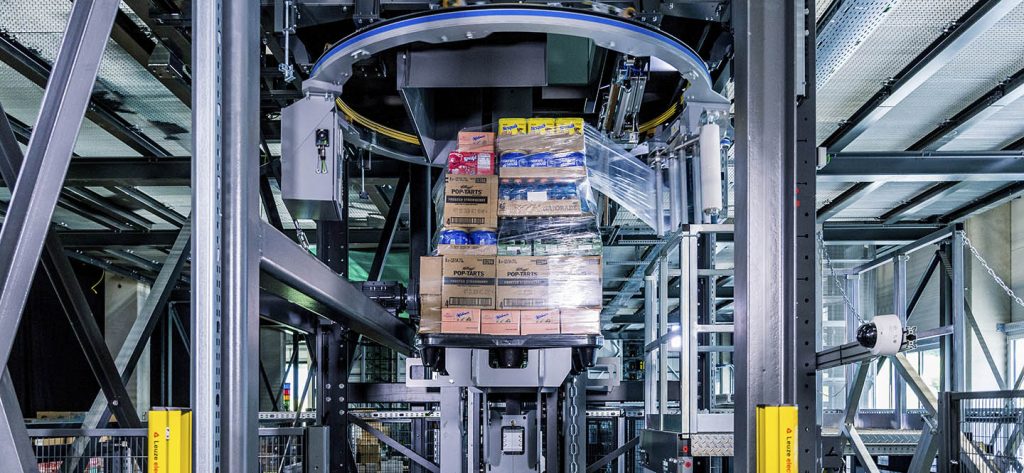
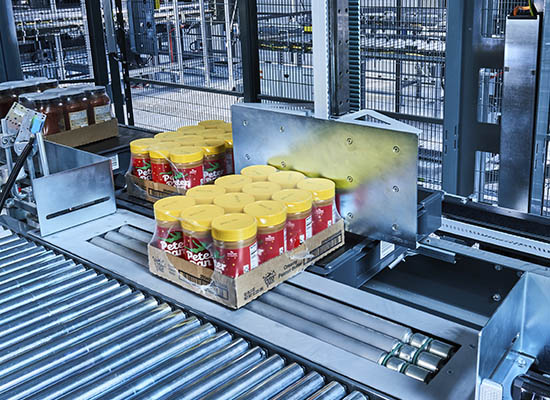
- An autonomous robotic palletizer assembles mixed pallets with unparalleled efficiency and then automatically wraps pallets in one seamless operation
- Autonomous mobile robots driven by software fully automate transport to the loading dock
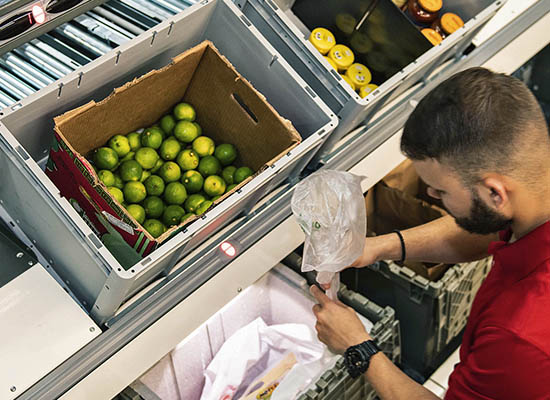
When the food retailer needs to increase eGrocery capacity, the DC can easily evolve to enable omnichannel fulfillment. That’s because all core automation technology has elemental expandability.
- Robots and Workstations can be easily integrated into the existing facility, which eliminates the need to build a new facility
- Additional shuttles can be simply dropped in and they self-configure, for easy scalability
- A modular microservices architecture allows for rapid reconfiguration
- A single shuttle system handles both fulfillment and in-store replenishment, eliminating the need to purchase a second system
- Software dynamically manages operations and resources using real-time intelligence of order structures, order profiles and SKU locations
Top Five Uses of Intelligent Logistics Software
- G2P picking
- Data-driven operations
- Automated data DNA collection, distribution and maintenance
- Data-driven maintenance
- Reducing CO2 emissions
Increase logistics intelligence and value over time.
At any time, the food retailer can add any or all four of these intelligent software capabilities to continuously drive performance improvements.
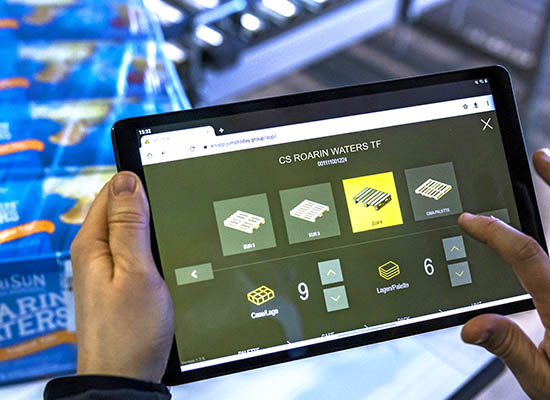
- Intelligent automation data system for decoding item DNA and giving palletizing robots a deep understanding of the items they touch. The self-learning system automatically collects, distributes and maintains master data for unprecedented robotics performance.
- Advanced logistics analytics for enhancing visibility, accelerating decision making and navigating the unexpected — all in near real time.
- Operations control tower for automating and optimizing every aspect of day-to-day operations — from resource planning and training to real-time performance optimization and continuous improvement using historical data.
- Intelligent CMMS for automating every aspect of maintenance and management — from scheduling to event-controlled repair, prescriptive repair, and lifecycle analytics.
By adding this software, operations are faster. Insights are deeper. Operational efficiency is continuously improved. Investment protection is longer.
Unparalleled agility and profitability.
Making a major modification like this with minimal impact to existing operations is only possible with modular autonomous robotics, intelligent logistics software and sector-specific expertise.
When everything is integrated, interconnected and intelligent, retailers can create value end-to-end through continuous improvement, inherent system flexibility and labor optimization. Sudden shifts in supply and demand are readily managed, and the opportunities that disruption brings are maximized.