Shaping the Future of eGrocery
A national grocer was among the first to pilot automated micro-fulfillment centers (MFCs). The grocery chain deployed its first automated MFCs in 2019 and opened seven new facilities in 2021.
The MFC pioneer has continued to evolve its MFCs to:
- Improve the economics of online order fulfillment
- Combat ongoing labor shortages and rising labor costs
- Easily scale eGrocery operations without expanding back-of-store MFC footprints
- Flexibly accommodate shifts in eGrocery demand and changes by grocer
The chain believes eGrocery will eventually constitute 20% of their business. To increase speed and accuracy without increasing space requirements, the grocer is deploying next-generation MFC technology.
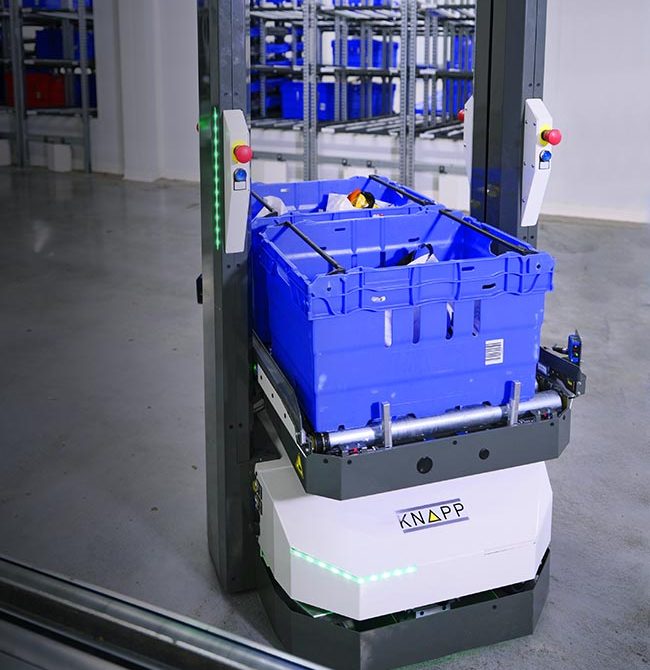
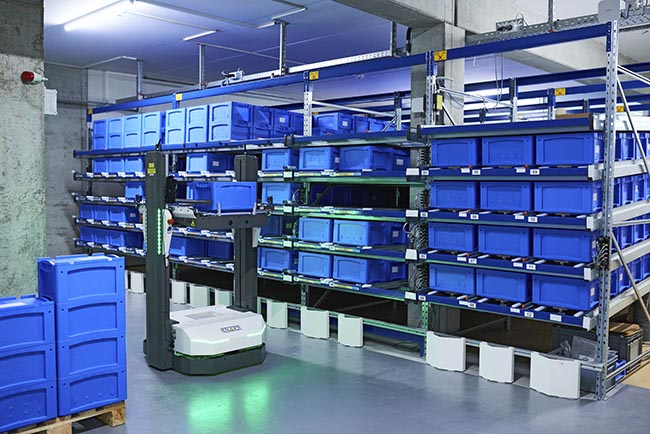
Next-generation MFCs are smaller, faster and easier to construct and install. They even increase storage capacity. Next-gen MFCs also use autonomous mobile robots (AMRs). These “open shuttles” roll independently within MFCs and are completely safe for use around people.
A fully integrated system ensures accuracy and efficiency
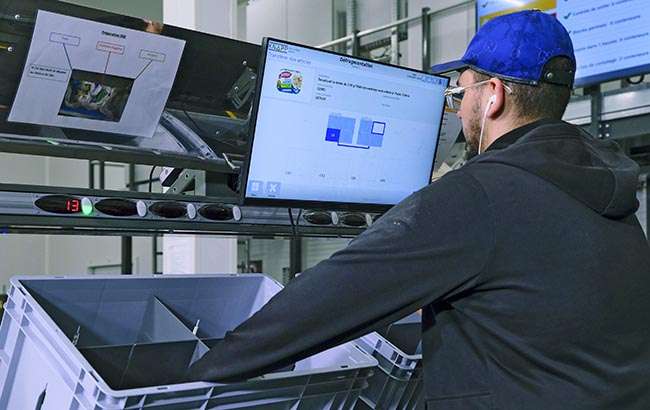
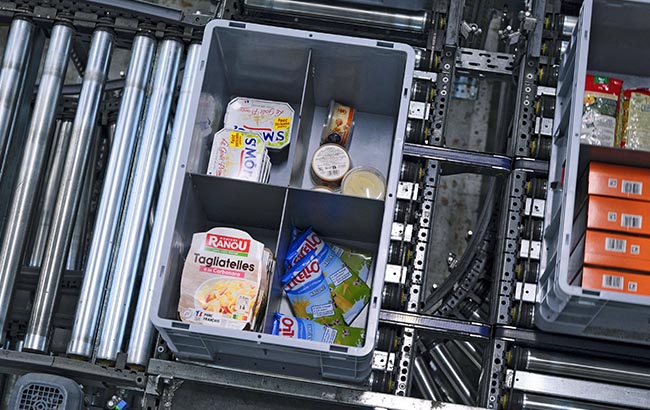
The AMRs easily integrate into the existing back-of-store footprints. Goods are stored in the robotic shuttle system and picked at goods-to-person workstations. Completed orders are transported by AMRs to a flow rack and assigned a buffer conveyor. This ensures that the right orders get to the right customers at the right time.
- 3D obstacle detection means AMRs can act with complete autonomy and are 100% safe for people.
- Fleet control software means intelligent route planning and independent processing of transport orders.
- User-friendly simulation means the grocer can test new systems and changes made to existing systems.
Up to 75%
in costs per order can be saved with automated micro-fulfillment solutions.
–CBINSIGHTS
Roughly 68%
of all U.S. shoppers consider themselves online grocery shoppers.
–KANTAR
Maximum freedom of movement in minimum space
The transport system requires very little space. Each AMR turns on its own axis so it can work in tight spaces with narrow aisles. The AMRs are more flexible, cost-effective and space-efficient than automated guided vehicles (AGVs). They’re also faster and easier to install because they require:
- No structural modifications
- No special pathways or fixed routes
- No additional markers
- No induction loops in floor
- No human oversight
The AMRs use virtual lines defined and managed by the intelligent fleet control software to enable smooth and efficient traffic flow. The software also ensures that the AMRs evade humans and other obstacles as they transport totes full of groceries.
The future is digital
The national grocer believes automated MFCs are a key element to future success. Their eCommerce business has become more strategically important. Their goal is to make eCommerce a competitive advantage. MFCs with AMRs will help it do that.