
Lower your carbon footprint without compromising performance.
The United Nations Department of Economic and Social Affairs says a whopping 70% of the world’s transport emissions come from road vehicles moving people and freight. This is obviously unsustainable, but understandable as companies struggle to meet growing service demands in an unpredictable, labor-restricted and increasingly cost-prohibitive environment.
Automation addresses many of today’s problems. It can also contribute to greenhouse gas emissions. It is possible for organizations to drive growth, maintain margins and meet ever-evolving customer demands while achieving ambitious sustainability goals. It requires a comprehensive, multi-pronged approach to every aspect of intra- and extra-logistics automation — from the technology partner you choose to product design to network wide strategies and everything in between.
Here are five things to look for if you want to lower logistics-related carbon emissions in a way that’s good for business and the planet.
1. Look for a technology partner that values environmental responsibility.
Sustainable logistics can’t be an afterthought. It can only be achieved through intentional planning and a sustained focus on self-sustaining systems. That means adherence to emissions-reducing principles, including:
- Responsible sourcing. GEODIS, the world’s leading transport and logistics provider, utilizes a sustainably sourced and designed shuttle system that optimizes every aspect of automated storage and retrieval. It’s part of an overall approach that strikes the right balance between performance, flexibility, scalability and sustainability.
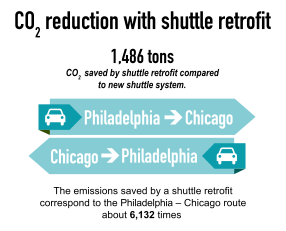
- Renewable systems. With rising costs for storage space and raw materials, retrofitting automation systems can be a sound business strategy. Retrofitting is significantly more sustainable than purchasing a new automated system. When the Schwarzwald Apotheke pharmacy in Germany retrofitted their automated dispensing system, the outdated robot got a new lease on life over the course of four nights. And the system continued to operate during the day without interruption.
- Recyclable materials. If Schwarzwald Apotheke had decided to purchase a new automated dispensing system instead of retrofitting the old one, they could take comfort knowing that the vast majority of materials (98%) in the KNAPP automated dispensing system are recyclable and have a new life ahead of them in different products.
2. Look for eco-friendly automation systems.
When selecting automation systems for modernization and expansion, companies should consider the environmental impact of systems. For example, look for:
- Space- and energy-saving/regenerating systems. By using a space-efficient shuttle system, Wurth Austria decreased the required space by about half in comparison to conventional storage and sorting systems. High storage density and making the best use of available height provided outstanding results in space utilization for this global manufacturer and wholesaler. It meant saving building costs and materials while significantly lowering heating and cooling requirements. Beyond these savings, the system itself is highly energy efficient. On average, it requires the least amount of energy consumption of comparable systems without compromising on performance. Braking energy from the lifts and shuttles is fed back into the system and the software optimizes shuttle transport routes, further contributing to energy conservation.
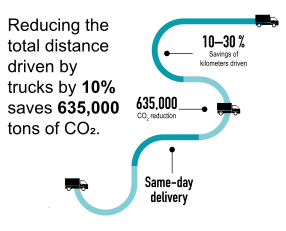
- Mile-minimizing systems. Forbes says, ”Taking steps to reduce transportation emissions can go a long way in reducing a company’s carbon footprint.” The transport of goods both within and outside warehouses can now be analyzed and optimized in real time. Software determines which routes goods should take as they move within and between systems, how vehicles can be optimally filled and what the most efficient route is at each decision point. A combination of transport route optimization and optimal truck loading reduces transport distance by 10 to 30%.
- Waste-reducing systems. Right-sizing packaging is now the law in New Jersey. REI, an international sports fashion retailer, was way ahead of this potentially new development for other states. The retailer was able to significantly reduce dunnage, shipping volume, transport weight and carbon emissions with an intelligent, right-sizing packaging system that works in perfect sync with other automation systems.
3. Look for whole-facility capabilities that enable more sustainable operations.
When automation systems are integrated and operations are data-driven, you can optimize inventory, minimize waste, reduce power consumption and increase space utilization. Look for advanced capabilities like these.
- Seamless sequencing. Integrating automation silos can elevate productivity facility wide. When national grocer Kroger modernized and expanded its Great Lakes distribution center (DC), they doubled capacity and significantly increased performance. A shuttle system and automated mixed palletizer work together in complete harmony to fully automate order preparation for 115 stores. The ability to replenish more stores from a single location makes good business sense and is more sustainable on a number of fronts.
- Omnichannel inventory. Specialty outdoor retailer, REI, was able to combine their entire omnichannel inventory, which includes products destined for stores and customers. The highly automated DC expands their domestic distribution footprint while improving delivery speed to customers and stores. The DC also increases throughput and storage capacity while lowering shipping, energy and space costs.
- Multiple workflows in one facility. Limedika, Eastern Europe’s largest pharmaceutical wholesaler and pharmacy chain, handles wholesale, central fill and mail-order prescriptions — all under one roof. A smart mix of automation hardware and software allows them to dispatch multiple deliveries every day to 1,500 pharmacies and hospitals. It’s a lean, mean medication-filling machine that’s also more sustainable.
4. Look for new business models that reinvent last-mile logistics.
By 2030, carbon emissions in 100 cities will increase by 30% because of last-mile deliveries, according to the United Nations Department of Economic and Social Affairs. Leveraging new models that bring distribution and fulfillment closer to consumers addresses both business and environmental concerns. Whether you’re a food, fashion, footwear or other type of retailer, consider the following business models to lower your costs and your carbon footprint.
- Rethink metro distribution. Metro logistics have a huge impact on the environment. This impact will only grow. By 2050, the United Nations Department of Economic and Social Affairs predicts that up to 60% of the world’s population will live in metro areas. Retailers can reduce emissions while increasing replenishment from once a day to multiple times a day by locating metro distribution centers (MDCs) within 20 miles of the city it serves. The MDC can even add direct-to-customer fulfillment at a later date for further emission reduction, because store and customer orders can be combined in one order.
- Reengineer eCom fulfillment. Whether deployed at the back of stores or in dark stores, automated micro fulfillment centers (MFCs) can help you be responsive to customers and environmentally responsible to the planet. Automated MFCs significantly reduce traffic and carbon emissions. They also make error-free fulfillment possible, which minimizes returns and associated emissions. Australian supermarket giant Woolworths already has four MFCs. Managing Director of WooliesX says, “Micro fulfillment is a real game changer for us. It’s provided us with incomparable speed and accuracy in order processing, as well as rapid and flexible delivery.” A high degree of automation allows the WooliesX team to sort more orders, open faster delivery options and more time slots for customers.
- Reimagine point of sale. New fully-automated, 24/7 click-and-collect stores combine warehouse and vending areas in one solution. German food retailer, EDEKA uses an automated in-store storage system. Once ordered, a robot picks goods and places them in a pickup window. The solution reduces storage requirements by 70% while raising throughput and performance and lowering costs. Employees are freed for more valuable tasks such as consulting with customers or cross-selling.
5. Look for network-wide approaches that deliver large-scale impact.
Supply chain leaders are no longer focused on automating individual tasks. They’re using logistics automation, big data and networking to improve efficiency across the entire network. By focusing on network solutions companies can propel productivity and sustainability end-to-end. Here’s how.
- No compromise hyper-local fulfillment networks. National grocer Albertsons was among the first to deploy a network of automated MFCs. The chain believes eGrocery will eventually constitute 20% of the business. To increase speed and accuracy without increasing space requirements, the grocer has deployed next-generation MFCs, which are smaller, faster and easier to construct and install.
- Albertsons can further extend its hyper-local network with a range of preconfigured fulfillment models for high-, mid- and low-volume eGrocery operations. Each model offers the best possible pricing by rightsizing automation, minimizing customization and speeding implementation. Any food retailer can construct a profit-driving, planet- saving hyper-local fulfillment network that fulfills their promise to consumers without compromising profitability or sustainability.
- Warehouse consolidation. Victorinox is a manufacturer, distributor and retailer. The company’s new highly-automated DC in Seewin consolidates 17 warehouse locations in three European countries into a single location that distributes their iconic Swiss Army Knife as well as cutlery, watches, travel gear and fragrances. This consolidation has certainly improved efficiency. Instead of separate deliveries for each product line, customers now receive a single shipment. This not only lowers the company’s environmental impact, it also lowers costs and increases customer satisfaction
- Low-touch logistics network. By building five new next-generation fulfillment centers (FCs), Walmart increased comfort for associates and service for consumers. The FCs also double storage capacity and the number of customer orders they can fill in a day. The same FCs also deliver marketplace items from Walmart Fulfillment Services.
- The FCs are more sustainable because of right-sizing packaging, giving customers the option to consolidate shipping on eCommerce orders and last mile delivery efficiencies that reduce mileage and delivery times. Moving forward, Walmart anticipates eliminating more than 2,000 tons of plastic by transitioning to paper bag mailers.
There’s never been a more exciting time for logistics. Innovative technology can help make logistics more profitable for the business, more attractive to workers, more desirable for consumers and more sustainable for the planet.

