
A Trends Report
Logistics software is evolving and maturing. Technology enablers like AI, machine learning, edge and cloud computing are converging to enable new use cases for robotics and automation.
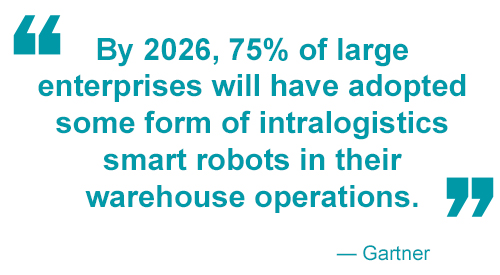
Smart is code for software. The shift to software-driven distribution and fulfillment is happening now. Today, logistics software automates just about everything — from collecting, distributing and maintaining automation data to building custom boxes for each order to optimizing every aspect of day-to-day operations. Intelligent logistics software is driving seismic shifts in logistics. Here are ten shifts you should follow closely.
1. The Shift:
Master Data to Item Data
Today’s master data wasn’t designed for robotics. It doesn’t include essential automation information such as packaging type, contents, center of gravity, tilting behavior, stackability, pickability and other item attributes.
A new category of software, — an automation data system — collects, distributes and maintains item DNA. Robots equipped with the right information function more efficiently, have less downtime and fewer damaged items.
2. The Shift:
Hard Coding to No Coding
If you want to avoid being stuck in pilot purgatory, make sure your robot has a brain. AI-enabled robots quickly learn to manipulate objects without being told what to do. They rapidly process visual information and identify the optimal gripper, gripping point and gripping speed. When new SKUs are introduced, the AI brain infers from past experiences, learns with every grip and shares learnings with other connected robots via the cloud.

3. The Shift:
Mostly Manual to Fully Automated
The majority of tasks and activities performed in distribution and fulfillment centers are done by human beings. That’s changing fast. Logistics leaders are now leveraging autonomous robotics for virtually every core intralogistics process.
Fully automating complex processes requires software for both orchestration and enablement. Software includes WMS, WCS, and machine control or SCADA software. An AI-enabled robotic platform with 3D perception and real-time motion planning is also needed, as well as an automation data system to ensure proper handling of individual items.
4. The Shift:
Shipping Air to Sustainable Packaging
Everyone it seems is talking about the growing impact of dimensional weight or DIM charges, which have just increased. When low-weight items are packaged in oversized cartons, companies have to pay extra essentially to ship air.
Sustainable packaging systems eliminate the air. By right-sizing packages, an international sports fashion retailer who ships around 6.2 million cartons a year can reduce:
- Dunnage by 30%
- Shipping volume by 45%
- C02 emissions by 31%
- Transport weight by 30%
Realizing these “green” benefits requires fully automated picking and packing solutions driven by intelligent logistics software. The software should seamlessly combine WMS, WCS, and machine control with automation data and packing software as well as an AI-enabled robotics platform.
All this integrated intelligence allows the system to build boxes to order size and weight requirements as soon as orders enter the fulfillment center. That means right-sized boxes are ready when items arrive.
5. The Shift:
Standalone Solutions to
Integrated Systems
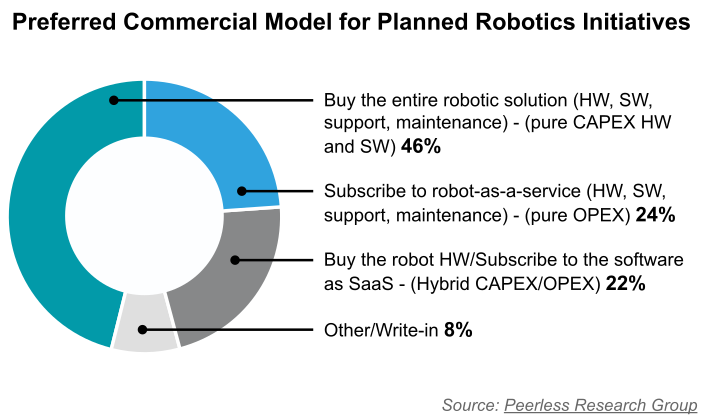
According to Peerless Research Group, 46% of supply chain leaders prefer integrated systems. When they buy robotics, they want the entire package: hardware, software, support and maintenance as a pure CAPEX initiative. It makes sense. Integrated systems for comprehensive solutions that automate entire intralogistics processes:
- Accelerate implementation timeframes
- Speed payback expectations
- Increase performance
By using a fully integrated system, one of the world’s largest retailers was able to double storage capacity and throughput in their new fulfillment centers. To do it, they deployed a massive automated storage system with intelligent logistics software.
The robotic shuttle system was engineered to seamlessly integrate with the software. This made it possible to reduce a 12-step process down to just 5 steps and achieve 30-minute “click-to-ship” fulfillment.
6. The Shift:
Gut Decisions to Real-Time Intelligence
For many operations managers, data is siloed and Excel is their decision support system. This is problematic with modern logistics. Real-time operational intelligence is now necessary for keeping up with the constant barrage of big and little disruptions.
A warehouse operations control tower can remove the latency between planning and what actually happens in real life. Decisions concerning a single warehouse or multiple facilities can be made in real-time.

The software sits above existing warehouse management, execution and control systems. It unifies data from all of these disparate systems as well as from devices, sensors and ERP systems.
The control tower software automates every aspect of day-to-day operations — from resource planning and training to performance optimization and continuous improvement using historical data.
AI-powered predictive modeling and prescriptive analytics give operators real-time updates and instant feedback into how they’re performing against expectations. Operations managers know what’s happening, why it’s happening, what’s likely to happen and what they should do about it.
7. The Shift:
Linear Logistics to
Dynamic Orchestration
SLAs are rapidly evolving from 2-day to 1-day to 2-hours and even 1-hour fulfillment. The growing need for speed can’t be adequately addressed with linear logistics. The foundational design is inherently unable to overcome the limitations of time and space.

Enter dynamic buffering and process decoupling. Instead of fixed paths, every source is connected to every destination. Intelligent logistics software enables structural, process and orchestration agility. Every process is fluid. Challenges are rapidly detected and mitigated. Picking stations are never backed up. Packing stations have a continuous supply of complete orders. Centralized order pooling sorts by carrier instead of by order.
The entire system is driven by software and fueled by data. It’s self-driving, self-adjusting, self-learning and self-optimizing.
8. The Shift:
Cost Center to Value Creator
The potential of intelligent, software-driven logistics is unprecedented. Logistics leaders that are effectively leveraging platforms are dipping into new customer pools and using differentiated services to create new revenue streams. Increasingly, leaders see these new services as their competitive advantage. When demand unexpectedly spikes? Software-driven, data-informed distribution and fulfillment functions can minimize and even prevent disruption.
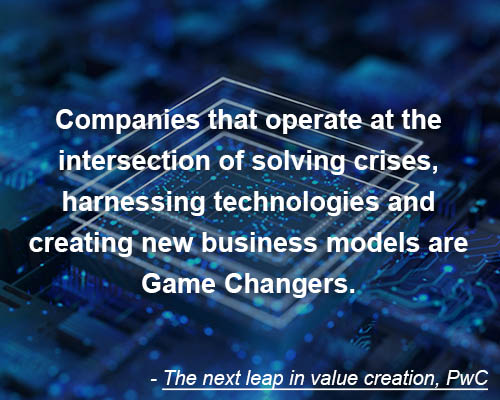
Leaders let go of legacy business models and create new ones. Laggards focus on supply chain basics like increasing efficiency and managing costs. PwC says, “They’re missing value creation opportunities in digitization, sustainability and transformation.”
The other side of this profit-building coin is using software-driven technology (e.g. autonomous robotics) to perform non value-added tasks previously performed by people. This not only improves worker safety, it reduces risk. It also lowers costs and increases revenue by enabling 24/7 operations and by leveraging AI and machine learning (ML) to continuously improve operations.
9. The Shift:
Driving Blind to Route Optimization
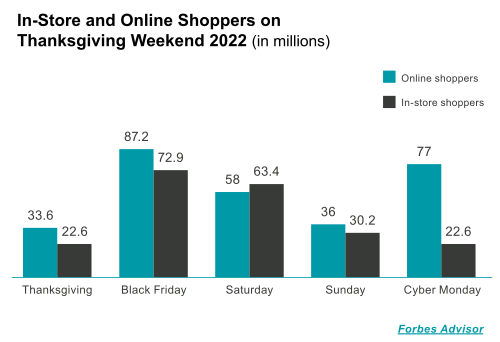
More than 164 million people shopped online for Black Friday and Cyber Monday in 2022. That’s a whole lot of shipping going on. Ensuring accurate, on-time delivery means bridging the gap between warehouse software and shipping software.
Route optimization software automatically distributes all orders across all vehicles and calculates the most efficient routes. It takes into account challenges drivers face on the road. It also helps ensure consumers get the speedy deliveries they want and timely information on arrival times.
Route optimization software better utilizes vehicles and drivers and reduces emissions and costs. Savings of 17% or more are not unusual. Even companies with smaller fleets can save anywhere from 7% to 15% through software-supported planning.
10. The Shift:
Fixed Automation to Modular Automation
Software is inherently flexible. It makes modular automation possible. Modular automation is like Legos for Logistics. It enables smaller parts of the whole to be rearranged, reconfigured and repurposed. With modular automation, logistics operations can begin with the end in mind. They can shift from low to medium to high-capacity operations at their own pace. Modular automation is available today and the benefits are sizable.

- Manual and robotic picking stations can be easily added or moved
- Picking robots can be moved to any environment and pick virtually any item with no additional programming
- Articles in robotic pocket sorters can be accessed from anywhere and at any time
- Autonomous mobile robots (AMRs) can be rapidly integrated and redeployed with the click of a mouse
- Shuttle systems can scale up and out, new shuttles simply dropped in and instantly become part of the swarm and can even support additional workflows
