Don’t leave money on the table!
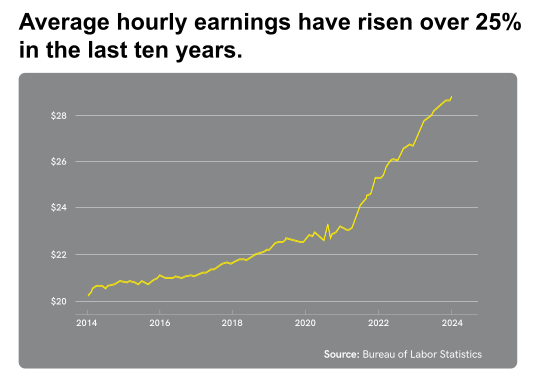
Rising labor costs, economic uncertainty and geopolitical instability have given rise to a new mandate for many operations managers: incrementally eke out every bit of efficiency possible from existing distribution and fulfillment centers. This is extremely difficult if not impossible when operations managers are flying blind, making decisions based on gut feelings or simply reacting to situations as they arise because they have no real-time visibility into operations.
Lower costs by raising labor utilization rates.
Labor is by far the biggest operating expense in logistics, yet it’s often overlooked in optimization initiatives. This is changing though, as operational labor costs continue to rise and other productivity sources have already been tapped. Improving labor utilization rates can drive down cost, but it requires a new type of tool that eliminates data boundaries, so you can comprehensively track direct and indirect labor. Depending on the size of the workforce, an increase of just two percentage points can save hundreds of thousands or even millions of dollars.
Why is it that so many operation managers struggle with labor utilization? First, visibility. They have no real-time insight into inefficient indirect labor processes. Second, workflow fluidity. Processes are imbalanced, which creates gridlock in one area while workers sit idle in another area. Third, staffing. Personnel are not properly positioned for the specific order profiles of incoming work.
An intelligent tool capable of warehouse orchestration, can derive actionable insights into inefficiencies, imbalances and improperly allocated labor.
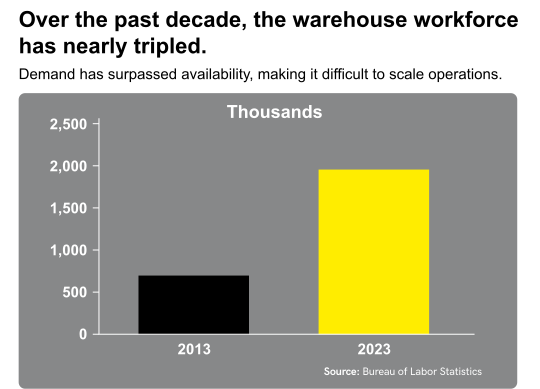
Optimize Staffing to Minimize the Impact of Peaks and Valleys in Demand
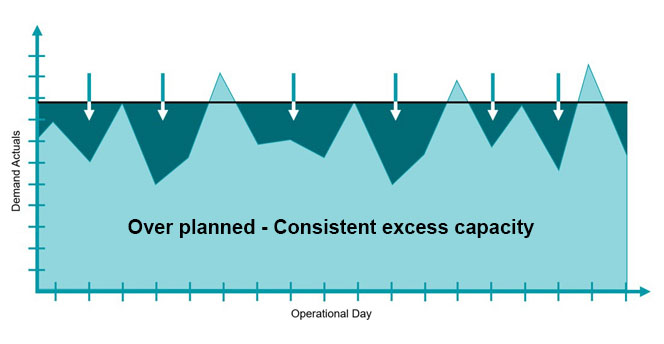
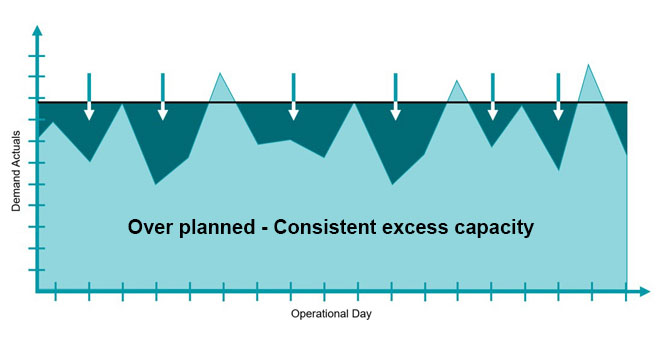
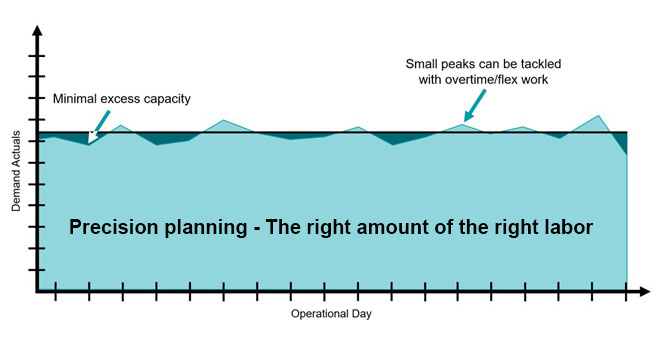
Filling efficiency gaps can help you incrementally raise labor utilization rates. Typically, the largest impact can be made in these four areas.
- Precise staffing and scheduling of warehouse resources – Creating labor plans that match the daily workload is critical. Under planning results in missed SLAs and upset customers. Over planning adds unnecessary cost to the operation. Starting the shift with a solid foundation makes it much easier to control flow throughout the day.
- Real-time monitoring of individuals and team performance – If operations managers don’t have the ability to monitor performance in real time, it’s extremely challenging to appropriately position staff. Efficient warehouse flow depends on multiple areas performing at the expected rate and action being taken before there is a noticeable problem.
- Finding hidden potential in manual, semi-automated and fully-automated processes – With granular visibility into every step of the workflow, “problem processes” quickly reveal themselves. These inefficient or flawed processes can have an impact on indirect overhead and quality. Oftentimes, inexpensive tweaks can be implemented to significantly improve processes.
- Preventing bottlenecks, backlogs and overcapacities – Uneven workflow results in too much work in one area and not enough in another area. When problems occur, labor utilization rates drop. It can be eye opening to see what a few seconds here and there add up to at scale.
Improve performance with data-driven insights
According to Global Trade, 77% of organizations are looking to maximize data-driven insights for performance improvements. An advanced operational excellence tool can unify data, so you can orchestrate every aspect of day-to-day operations. Here are five critical elements to look for when selecting an operational excellence tool.
- Holistic scheduling of all warehouse resources, so operations managers can optimize every aspect of operations, pre-, during- and post-shift. Moving from manual to automated scheduling can help you reduce over/under planning, which will ultimately increase customer satisfaction while decreasing cost per shipped unit.
- Real-time decision support, so operations managers can get instant feedback into how they’re performing against expectations and prevent bottlenecks, backlogs and overcapacities.
- Dynamic order release mechanisms, so operations managers can precisely orchestrate the flow of goods and simultaneously coordinate people, processes and automated systems by balancing the workload to be done with the workforce available to do it.
- Detailed process visibility, so operations managers can leverage historic performance data to identify gaps in the pick-pack-ship process and better understand the true performance of people and processes.
- Machine learning and predictive analytics, so operations managers can make better, more informed decisions and spend more time on the floor with their team and less time digging through excel spreadsheets.
With these capabilities, you can get highly productive work from each and every employee every hour of every shift.
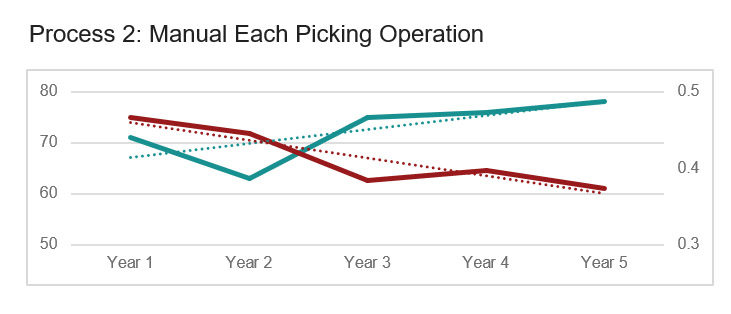
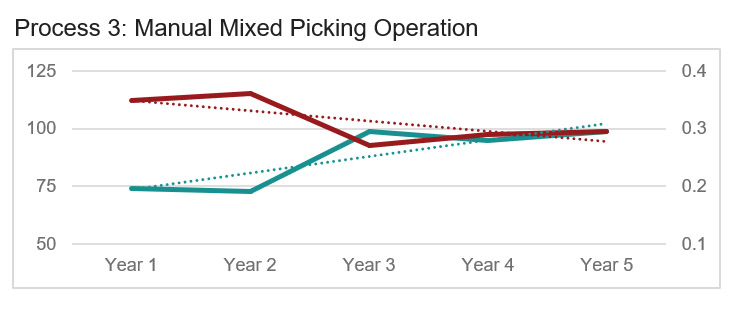
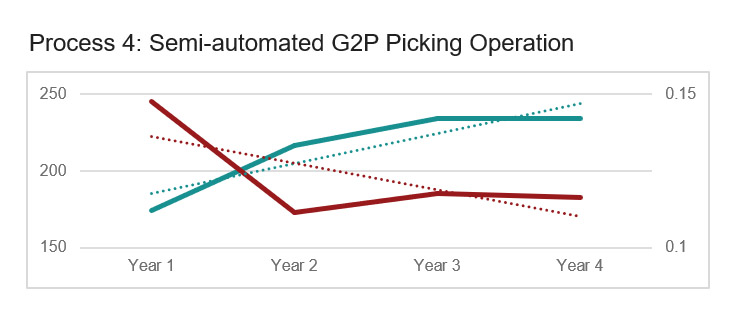
Labor Cost Savings and Efficiency Gains After Implementing redPILOT Operational Excellence Tool