
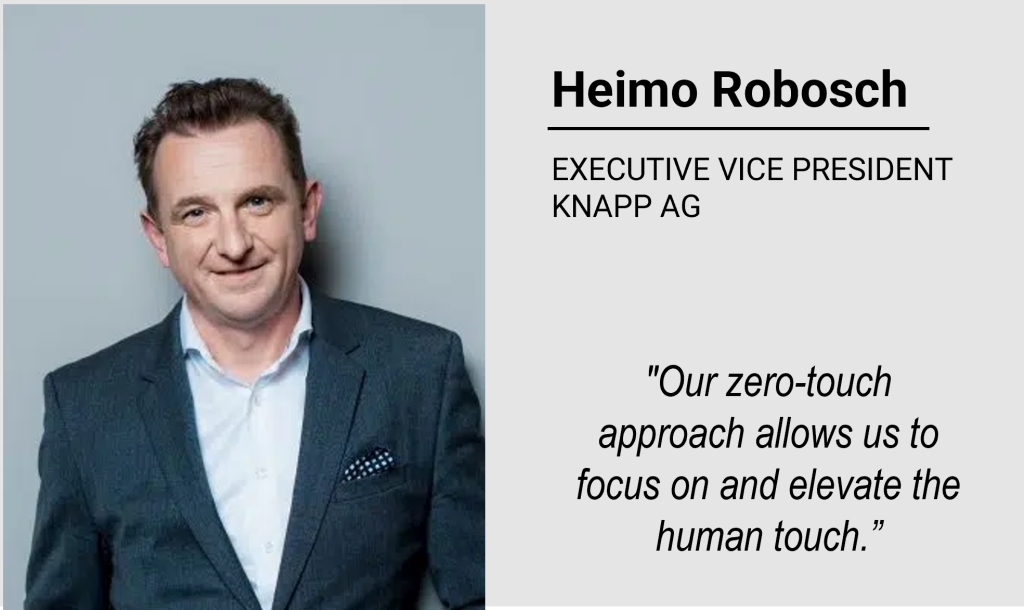
Some of the world’s biggest and best supply chains are winning with low-touch logistics from KNAPP. A bold vision for the future is helping the company build competitive advantage in an industry fraught with disruption. In this article, KNAPP’s C-suite shares their views on why low-touch logistics is the answer.
Doesn’t all this automation take up a lot of space?
On the contrary, our low-touch logistics do more in less space because a lot of functionality is integrated into a single system. For example, our all-in-one shuttle system handles storage, temporary storage, picking, buffering, sequencing and supplying Workstations and work areas. It does all this in a space-efficient, storage-dense way. It makes the most of every square inch of warehouse space from floor to ceiling. Customers use it for eCommerce, micro fulfillment and omnichannel distribution.
Our zero-touch pocket sorter solution for the fashion industry is another great example of effective space utilization. It handles the entire fulfillment process fully automatically — from storing clothes, loading them into pockets, picking, sequencing and packing. It even integrates order and stock management systems. Tasks previously performed manually no longer need human intervention.
The online fashion giant NEXT is overcoming space and time limitations with zero-touch logistics that leverage overhead conveying, sequencing and dynamic buffering pocket sorters. They essentially “elevated efficiency,” taking advantage of previously unused overhead space. The next-generation pocket sorter whizzes through the warehouse, processing 15,000 items per hour. Self-opening pockets automatically empty flat goods into containers, cartons, roll containers or directly into shipping bags — without slowing down. Add our picking robot and you can auto-induct goods. The system is ideal for eCommerce, returns handling and reverse logistics.
AMRs also eliminate space constraints while providing unparalleled flexibility for our customers. Our fully automatic transport systems create a bridge between different warehouse areas. They navigate freely without optical or physical aids. Fronius, a global leader in battery charging, welding systems and solar systems uses AMRs for pallet transport. Even their trash containers are transported automatically.

How is Mission: Zero-Touch helping customers address today’s ongoing and growing challenges??
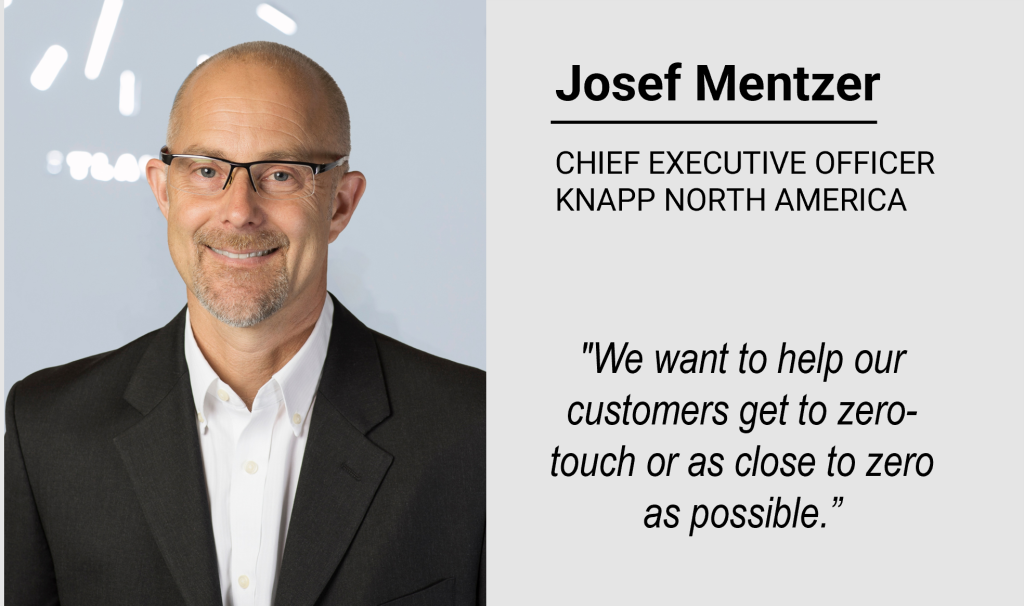
Disruption, labor issues, inflation, space constraints and sustainability aren’t going away any time soon. Our strategy for dealing with all of these issues is to increase the degree of intelligent automation in order to minimize the number of manual work steps. This is what drives us. We want to help our customers get to zero-touch or as close to zero as possible.
Zero-touch isn’t a feature of a single system. It’s a mission to reduce complexity by applying the right combination of software, robotics and sector-specific expertise, based on a company’s needs, goals and aspirations.
Our experience working with logistics leaders in North America and around the world has shown us that low and no-touch logistics has the power to help workers be more efficient and provide more value to the organization. Fewer manual touches also helps reduce lead times, eliminate errors and lower costs through increased efficiency, better resource utilization and decreased waste.
We build value across the logistics supply chain by distributing intelligence everywhere; at every level of the software hierarchy, including analytics. We provide modular robotic systems that fully automate core logistics processes such as order processing, picking, transport, palletizing and more. While these systems are offered as separate solutions, they are all designed to work together.
The “smaller-parts-of-a-whole” design provides many benefits to our customers: seamless integration, incremental implementation, rapid reconfiguration, systemwide optimization and robotic mobilization between processes. It’s really the only thing that makes sense in a world filled with disruption.
Our modular solutions create stability for customers. They make it possible for logistics operations to scale and continuously adapt to disruption while creating new value through the invention and reinvention of logistics processes and customer services. They also enable organizations to drive significant growth and achieve ambitious sustainability goals while maintaining margins and meeting ever-evolving customer demands.

How does low-touch logistics address the labor problem?
When it comes to attracting and retaining labor, the goal of our zero-touch vision is to relieve people from strenuous, ergonomically unsound jobs and give them more valuable tasks.
We believe this is the right way to shape the logistics workplace of the future. We’re working hard to design a better interface between people and technology to appeal to the young, tech-savvy generation.
Our technologies support the fundamental shift in logistics from a push to a pull system. By bringing goods to people, we’re helping one of the world’s largest retailers double throughput and capacity while improving the employee experience.
Low-touch logistics provide more comfort for employees who no longer need to walk miles every day. New, tech-focused jobs will command higher wages for employees, making it a more attractive place to work. The retailer’s new fulfillment centers provide 95% of the US population with next or two-day shipping on millions of items, so the customer experience is enhanced as well.
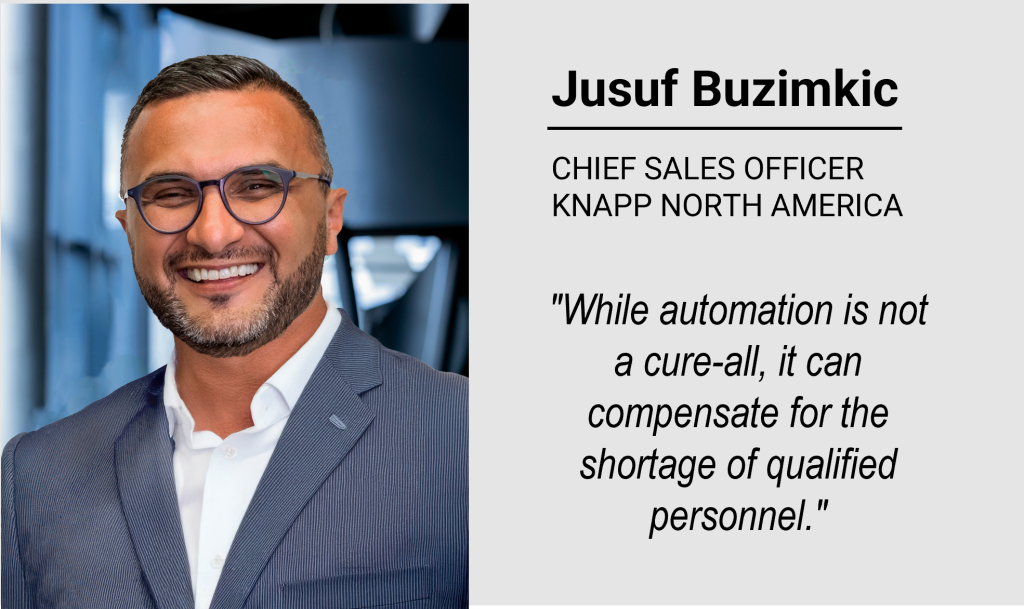
Here’s another example. Retail pharmacies are in dire need of a major transformation. Pharmacies are understaffed. Pharmacists are overworked. Patients are put at risk. With the right combination of technology, pharmacies can automate just about every aspect of prescription filling and pickup. This frees pharmacists to spend more time with patients and creates space for new revenue-generating services. It’s about how best to utilize the limited personnel you have in the most profitable way. While automation is not a cure-all, an increasing degree of automation — and for some processes full automation — can compensate for the shortage of qualified personnel.
Another way we help? Developments in software — especially AI and machine learning algorithms — are evolving the way logistics companies manage labor. As the top operating cost for logistics, operators increasingly rely on our warehouse operations control tower for help with resource planning and optimization.

How do lower-touch logistics enable “greener” logistics?
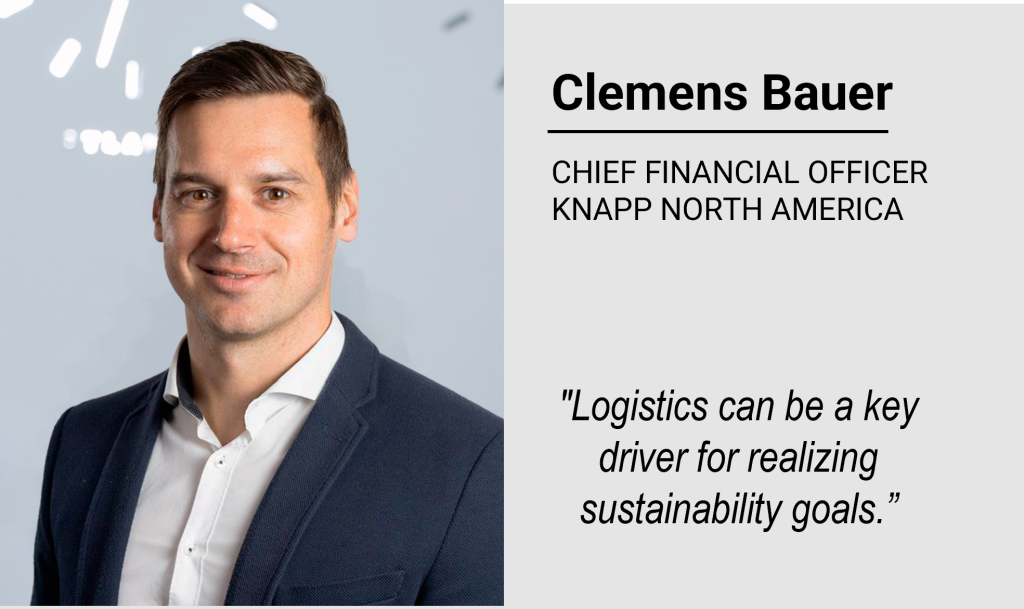
You cannot have a sustainable organization, without a sustainable supply chain. We believe logistics can be a key driver for realizing sustainability goals. Whenever possible we renew instead of rebuild. We are currently running a comprehensive retrofit program for our first-generation shuttle systems.
This includes refurbishing mechatronics and software during live operation, which for us is a little like performing open heart surgery. Renewing instead of building new significantly contributes to sustainability.
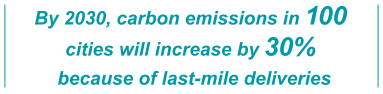
Demand for last mile logistics is growing and with good reason. By 2030, carbon emissions in 100 cities will increase by up to 30% because of last-mile deliveries. Obviously, this is unsustainable.
Our automated micro fulfillment centers (MFCs) significantly reduce traffic and carbon emissions. Intelligent software determines the most eco-friendly routes. MFCs make error-free fulfillment possible and minimize returns and associated emissions. Woolworths, a long-time customer, uses multiple sales channels sustainably by reducing unnecessary, circuitous deliveries and optimizing delivery routes all the way to consumers.
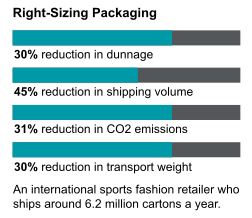
Automated packaging systems also contribute to greener logistics. When low-weight items are packaged in oversized cartons, companies have to pay extra essentially to ship air. Intelligent packaging systems build boxes to order, size and weight requirements, eliminating the air. By right-sizing packages, an international sports fashion retailer was able to realize greener logistics by significantly reducing dunnage, shipping volume, carbon emissions and transport weight.
These are just a few of the many ways we enable more sustainable logistics operations. We are currently focused on environmental, social and governance (ESG) reporting and have initiated a program to advance our ESG activities. The goal is to create transparency and help us improve in these areas.
How do zero-touch innovations help retailers mitigate inflation?
After eCommerce skyrocketed, the market is still trying to find the right balance of brick and mortar and online retail. Overall, the trend in food retail leans increasingly towards automation as labor shortages and inflation continue to be hot topics. We are helping our customers master the challenges posed by these developments.
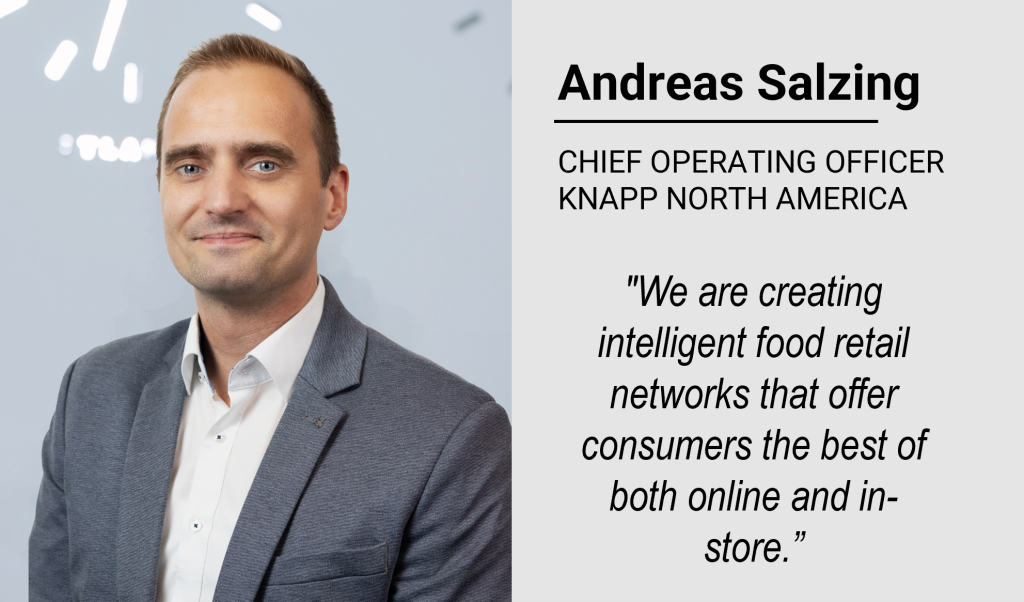
By joining forces, we are creating intelligent retail networks that offer consumers the best shopping experience — both online and in-store. Automation helps on both counts and is at the heart of modern food retail networks.
KNAPP’s innovative automation concepts ensure efficient processes across all business models, from eCommerce and store replenishment to in-store solutions at the point of sale. Robot technology and AI-based systems offer the best potential for automation. We’ve developed robotic systems specifically for food retail, including fully-automated mixed palletizing for store replenishment as well as back-of-store robotic order processing and robotic picking for eCommerce fulfillment.

